Will your boat clear the bridges between your Fort Myers canal and the Gulf, and will the lift at that home actually fit your vessel? These details can make or break a waterfront purchase or sale. If you understand how bridge clearance works, where to check official data, and what permits and maintenance a lift requires, you can move forward with confidence. This guide gives you clear steps, local contacts, and trusted sources so you can verify everything before you commit. Let’s dive in.
Bridge clearance basics
Bridge clearance is the vertical distance from the water surface to the lowest part of a bridge in its closed position. Your boat’s air draft is the highest fixed point on your boat, such as a mast, radar arch, T‑top, hardtop, or antenna. If your air draft is higher than the bridge clearance at the time you pass, you cannot safely get under that bridge.
Tides and water levels change. Published clearances are often tied to chart datums. Actual clearance at any moment depends on the tide and river flow. In Fort Myers, tidal swings are modest compared with the open Gulf, but they still matter.
How clearances are measured
- Fixed bridges list clearance to the lowest structural point.
- Movable bridges list clearance in the closed position. Openings are governed by federal rules and posted schedules.
- Clearance signs at bridges help, but you should still verify with official sources and tide predictions.
Verify bridge data
Start with official navigation tools and add on‑site checks:
- Review bridge symbols and notes using the NOAA Chart Viewer for the Caloosahatchee River and Fort Myers canals. You can access the official charts at the NOAA Chart Viewer.
- Check daily tide predictions for your nearest station through NOAA Tides & Currents. Compare low and high tide windows to your route.
- For movable spans or special rules, confirm bridge operating details through the U.S. Coast Guard Navigation Center. Look up bridge regulations and any local notices.
- Visit the site. Observe posted clearance boards and measure during both low and higher water. When in doubt, get a marine contractor or surveyor to assist.
Air draft checklist
- Measure from the waterline to your tallest fixed point. Include antennas or lights that do not fold.
- If an antenna or mast can fold, confirm how quickly and safely you can lower it while under way.
- Compare your measured air draft to the bridge’s clearance at the expected tide, and add at least 1 to 2 feet of safety margin for waves, wake, and error.
- If your route includes several bridges, use the lowest clearance as your go/no‑go metric.
Fort Myers canal realities
Fort Myers sits on the Caloosahatchee River with a web of tidal canals that connect to Pine Island Sound and Matlacha Pass. Some canals handle only smaller boats or kayaks, while others offer deeper draft and straightforward access to open water. The bigger your boat’s profile, the more you must confirm clearances along your exact route.
If you plan to keep a flybridge boat, a tower, or a sailboat with a tall mast, you need accurate clearance and tide windows for every bridge between the home and the river or sound. Small center consoles and deck boats often have fewer issues but still need confirmation.
Boat lifts and your route
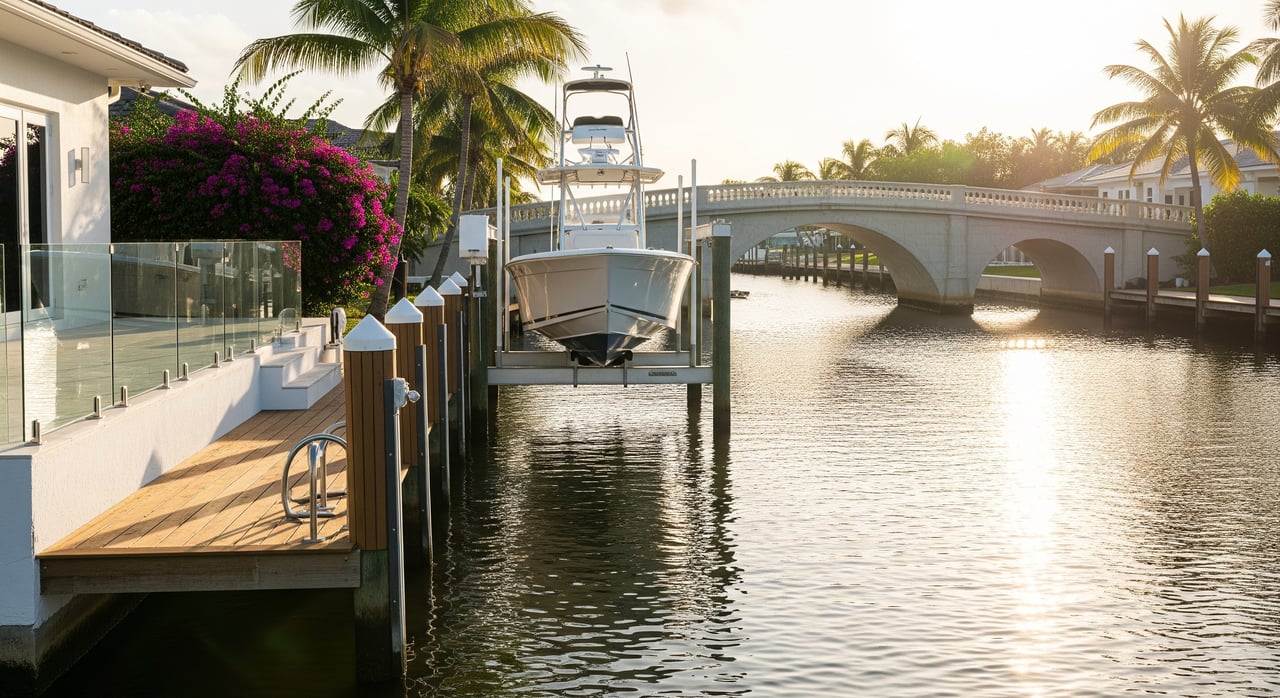
A lift makes ownership easier by keeping your boat out of the water, but it does not solve a low bridge on your route. Your boat must both fit the lift and pass under every bridge you need to transit. If you add a T‑top, radar, or tower later, your air draft changes. Some homeowner associations also regulate lift heights, canopy use, and boat types. Confirm these details early.
Permits and contacts
Lift and dock work often needs permits at multiple levels. Start local, then check state and federal layers.
- Lee County processes permits for docks, lifts, and seawalls in unincorporated areas. You can review permitting and development services through the Lee County government site.
- If the property is inside the City of Fort Myers, you will apply with the city’s building and permitting department.
- Many structures waterward of the mean high water line need state authorization. Review requirements through the Florida Department of Environmental Protection.
- Work in waters of the United States can require federal authorization. The U.S. Army Corps of Engineers, Jacksonville District provides regulatory guidance and permit pathways.
- Environmental resources like seagrass or mangroves can affect approvals. The Florida Fish and Wildlife Conservation Commission offers guidance on protected habitats.
When are permits needed? Any dock, piling, boat lift, boat house, or seawall that extends waterward of your property lines typically requires local permits and often state authorization. Minor repairs may qualify under specific provisions, but you should ask for documentation of the original permitted structure and any subsequent approvals.
What to request from the seller
- Copies of permits and any as‑built drawings for the dock and lift
- Proof of state authorization if the structure occupies sovereign submerged lands
- Records of inspections, maintenance, or code notices
- Documentation of easements or deeded rights that support the dock or access
Buyer steps before you commit
Use this checklist during your offer or inspection period:
- Confirm boat specs, especially your maximum air draft. Include antennas and accessories.
- Use the NOAA Chart Viewer to note bridges along your route, then check tides with NOAA Tides & Currents. Compare your air draft to the lowest bridge and add a safety margin.
- Request dock and lift permits, plus as‑built drawings. Confirm the structures match what is on site.
- Verify whether the dock or lift occupies sovereign submerged lands and whether state authorization is on file with FDEP.
- Confirm property lines, riparian rights, and any easements that affect the dock or access.
- Check channel depth at mean low water near the dock. Make sure your boat’s draft and tide windows work.
- Inspect the lift: piles, beams, cradles, cables, motors, pulleys, wiring, and corrosion. Consider a marine contractor for a written report.
- Review insurance. Confirm wind and flood coverage for the property and lift, and your boat insurer’s requirements for storage on a lift.
- Read HOA or neighborhood rules for any limits on lift height, canopies, or boat type.
- Call local marine contractors for neighborhood tips and practical constraints.
Choosing the right boat lift
Not all lifts suit every canal. Your boat type, canal width, currents, and seawall condition all factor into the right choice.
- Two‑post and four‑post piling‑mounted lifts are common and stable in salt or brackish canals. They keep hulls clean and make maintenance easier.
- Hydraulic or electric platform lifts raise the boat on a platform when pilings are limited or boarding is a priority.
- Floating “pallet” lifts are less intrusive but may struggle in stronger currents.
- Seawall‑mounted lifts can work where space is tight but require a sound seawall and proper anchoring.
Match the lift’s rated capacity to your boat’s real‑world weight, including fuel, water, and gear. Make sure the bunks fit your hull shape.
Maintenance and lifespan
Salt and brackish water are tough on metal and electrical systems. Plan for regular care:
- Inspect cables or straps, pulleys, and winches for wear and corrosion.
- Check wiring, switches, and motors with proper GFCI protection.
- Use sacrificial anodes and corrosion‑resistant materials.
- Ask how the system is secured for storms and how power is managed during outages.
Lifespan depends on materials and maintenance frequency. Stainless or well‑galvanized parts and routine service extend useful life.
Costs and quotes
Lift and dock project costs vary by capacity, materials, electrical or hydraulic components, site access, and permitting complexity. Treat any online range as a rough guide and get multiple local quotes that include permit, installation, and electrical work.
Environmental, insurance, and HOA factors
- Environmental: Seagrass, mangroves, and fish habitat can limit placement or require mitigation. FDEP, USACE, and FWC may apply extra conditions where sensitive resources are present.
- Insurance: Waterfront homes often sit in flood zones. Your insurer may ask about the dock and lift, storm prep, and electrical safety. Boat insurers often require that storage is permitted and that you have a hurricane plan.
- HOA and neighborhood rules: Some communities limit dock size, boat length, lift height, or canopies. Always review recorded covenants and design guidelines.
Hurricane readiness
Have a plan before storm season:
- Know how high the lift can safely raise the boat and whether you should remove the boat in a major storm.
- Secure bunks and tie‑downs and disconnect shore power as directed by your installer.
- Ask your contractor for written storm procedures and keep them with your property records.
How Pelican Vista helps
Understanding bridge clearance and lift details is part of buying the right waterfront home. Our team pairs on‑the‑water context with careful due diligence so you can match your boat to the right canal, confirm route clearances, and secure the permits and documentation you need. Whether you are local or remote, we help you focus on lifestyle while staying compliant and informed.
Ready to talk through your route, lift options, or a property you have in mind? Connect with the local team at Pelican Vista Realty and get a customized plan for your Fort Myers waterfront search.
FAQs
How do I measure boat air draft for Fort Myers canals?
- Measure from the waterline to your tallest fixed point, include antennas that do not fold, then add 1 to 2 feet as a safety margin before comparing to bridge clearances.
Where do I find official bridge clearance data near Fort Myers?
- Use the NOAA Chart Viewer for bridge symbols and notes, check tides on NOAA Tides & Currents, and confirm rules with the U.S. Coast Guard Navigation Center.
Do I need permits for a dock or boat lift in Fort Myers?
- Yes, most docks, lifts, and seawalls need local permits and often state or federal authorization; start at Lee County Development Services, then review FDEP and USACE Jacksonville.
What documents should a seller provide for an existing lift?
- Ask for permits, as‑built drawings, maintenance records, and any state authorization if the structure occupies sovereign submerged lands.
Can I install a lift if the seawall is older?
- Possibly, but you should have a marine contractor evaluate the seawall’s condition and anchoring needs before planning a lift or platform.
How long do lifts last in saltwater and what do they cost?
- Lifespan depends on materials and maintenance, and costs vary widely by capacity and site; get multiple local quotes that include permits and electrical work.
Are there height limits for lifts or HOA rules?
- Many communities regulate lift height, canopies, and boat size, so review recorded covenants and design rules before you buy or build.
How should I prepare a lift for hurricanes?
- Follow your installer’s storm procedures, secure the boat or remove it when advised, raise the lift only within safe limits, and disconnect power when directed.
Do I own the submerged land under my dock in Florida?
- Some installations occupy sovereign submerged lands that require state authorization from FDEP, so confirm rights and approvals before building or buying.
Will insurance cover my boat on a lift?
- Many insurers cover boats on lifts if the lift is permitted and secured per guidelines, but coverage and conditions vary by carrier and policy.