In May, Cape Coral's city council sat down to debate whether to borrow up to $65 million. The money would go toward four projects: improvements at Jaycee Park, irrigation work at the Coral Oaks golf course, road work on the North 1 West transportation corridor, and a new seawall at the municipal Yacht Club. Councilmember Rachel Kaduk pushed back hard. The city, she pointed out, already had close to $30 million in unassigned cash sitting in the general fund, on top of roughly $11 million from the recent sale of the Seven Islands property. "We should not be borrowing $65 million," she said.
Council authorized the bond anyway, under Ordinance 27-26. Of that package, $23 million is earmarked for the Yacht Club seawall alone, more than the Jaycee Park renovation and more than double the road project.
That number is worth sitting with if you own, or plan to buy, a home on one of Cape Coral's canals. A city with tens of millions of dollars on hand still chose to finance a seawall rather than pay for it outright. That is not a story about municipal budgeting. It is a preview of what the same category of infrastructure costs everyone else, and a reminder that the decision to defer it rarely gets cheaper with time.
What $65 million actually buys
The four projects funded under Ordinance 27-26 add up to $58.2 million: $18.7 million for Jaycee Park, $2.5 million for Coral Oaks irrigation, $14 million for the North 1 West transportation corridor, and $23 million for the Yacht Club seawall. City staff have said repayment on the seawall and park work will come from the general fund, while the road project draws on the city's six-cent gas tax.
The Yacht Club project itself has been years in motion. Storm surge from Hurricane Ian, which made landfall in September 2022, tore into docks and seawalls at the site, and the city has spent the time since securing environmental permits, finalizing design phases, and sequencing construction so the marine work, demolition of damaged docks, the boat ramp, and the seawall itself happens before any building construction begins. City staff have described the seawall and dock demolition as prerequisites for everything else planned at the park.
The lesson for a homeowner is not about permitting timelines. It is about sequencing. The city treated its seawall as the thing that had to be solved first, not the thing that could wait until the rest of the project was underway. Most private sellers do the opposite.
The wall behind your dock isn't on the form you signed
Since October 1, 2024, Florida law has required sellers of residential property to complete a written flood disclosure before or at the time a sales contract is signed, under Florida Statute 689.302. The law was expanded again in October 2025 to widen what counts as disclosable flood history. It is a meaningful protection for buyers, and every Cape Coral seller should take it seriously.
It is also narrower than most people assume. The form covers whether the seller has filed an insurance claim for flood damage, whether they have received assistance for flood damage, and, since the 2025 expansion, whether they know of flooding that damaged the property during their ownership. Read it closely and you will notice what is missing. Nothing on that form asks about the seawall itself. Not its age, not the condition of the cap, not whether the tiebacks have ever been inspected. A seller can complete the flood disclosure accurately and completely and still say nothing about a wall that is visibly leaning.
That gap does not mean the seawall goes unmentioned in a transaction. It means a different, older piece of Florida law is doing the work instead.
What actually governs disclosure on a private seawall
In 1985, the Florida Supreme Court decided Johnson v. Davis, a case that grew out of a home sale where the sellers knew about a defective roof and said nothing. The court ruled that when a seller knows facts that materially affect a property's value, and those facts are not readily observable by the buyer, the seller has a duty to disclose them. That standard has held up for four decades and is the reason Florida moved away from a strict buyer-beware approach to residential sales.
A seawall that is visibly bowed or cracked is the kind of thing a buyer walking the property could reasonably be expected to notice, and courts have generally treated obviously observable conditions differently from hidden ones. But a wall that looks fine from the lanai, with cracking below the waterline or corroding tiebacks nobody has checked in over a decade, sits closer to the kind of latent, material defect Johnson v. Davis was written for. Sellers who know their wall has problems and say nothing are not protected by silence just because the flood disclosure form did not ask.
This is the part of the transaction where a marine inspection stops being optional homework and starts being the thing that determines who controls the timeline.
What an inspector is actually looking for
A seawall inspection on a standard residential canal lot usually takes an hour or two and involves two distinct passes. Above the waterline, an inspector documents the cap for cracks, checks joint condition, and looks for rust staining that signals corroding rebar inside the concrete. Below the waterline, a diver checks the panel toe, the joints, and the surrounding bottom for scour or soft spots that suggest water is moving soil out from behind the wall.
The measurement that tends to decide whether a wall gets repaired or replaced is rotation, meaning how far the top of the wall has tilted out of plumb. Roughly two inches of rotation is typically treated as an early warning sign. Once a wall has rotated four inches or more, the project usually shifts from a repair job to a full replacement, because that much movement generally means the structure supporting the wall has already failed.
None of this is exotic. Insurance carriers and buyers alike are asking for these reports more often, which means a seller who has not had one done recently is negotiating with less information than the person across the table.
What it actually costs
Based on 2026 pricing from Southwest Florida marine contractors, vinyl sheet pile seawalls typically run $400 to $650 per linear foot, while concrete panel walls run $650 to $900 per linear foot. Concrete generally lasts longer, but the gap in upfront cost is real.
| Material | Cost per Linear Foot (2026) | Typical Lifespan |
|---|---|---|
| Vinyl sheet pile | $400 – $650 | 25 – 35 years |
| Concrete panel | $650 – $900 | 30 – 50 years |
On a standard 80 to 100-foot canal lot, that puts a full replacement somewhere between roughly $32,000 on the low end for vinyl and $90,000 on the high end for concrete, before permits, demolition of the old wall, or unexpected tieback repairs are added. Those extras are common enough that contractors treat them as the norm rather than the exception on canal-front work, since a crew often cannot know what condition the anchoring is in until the old wall comes out.
That is a wide enough range that finding out during a fifteen-day inspection period, with an offer already on the table, is a very different experience than finding out six months before listing.
Eight Lakes: what waiting actually looks like
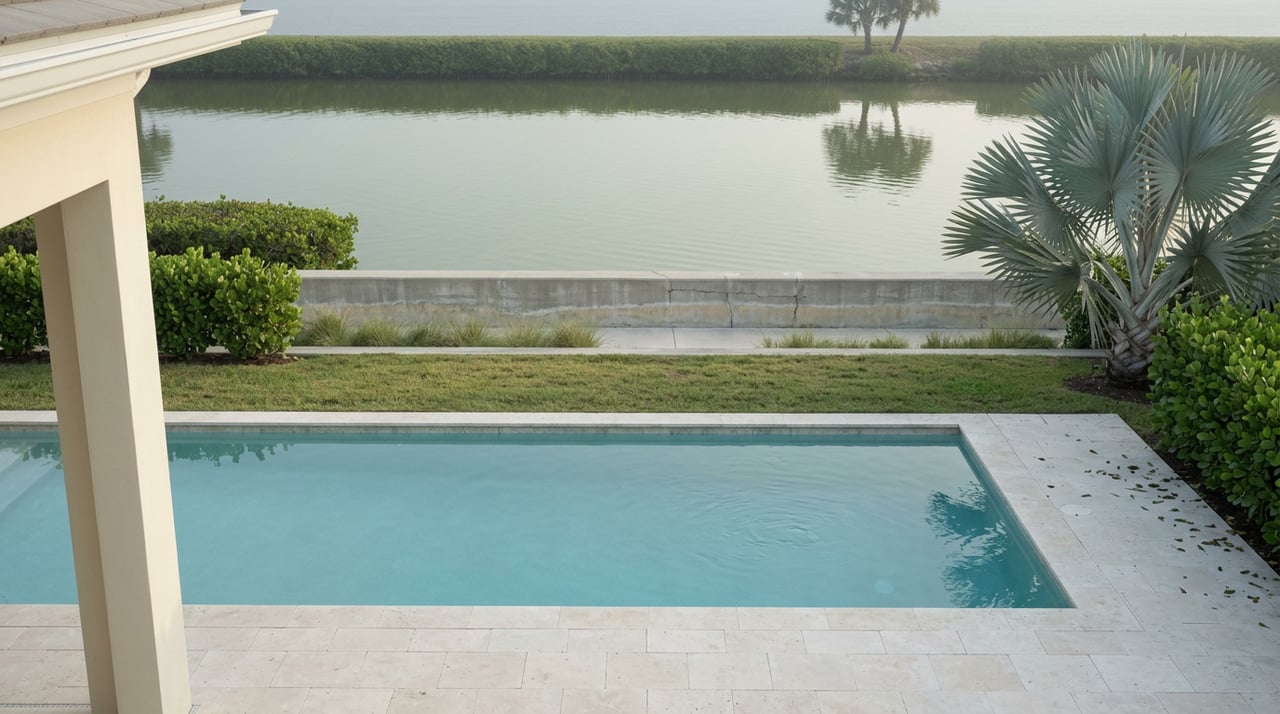
Cape Coral's Eight Lakes neighborhood sits around a chain of eight connected saltwater lakes with access out to the Gulf. It is the kind of setting that makes the city's canal system worth owning into in the first place. It has also been the site of a well-documented seawall failure, where a 320-foot section of concrete wall began leaking and showing structural stress. Homeowners in the area reportedly tried patching the problem themselves with soil and fill dirt before bringing in a marine construction crew, Seawall Savers, whose assessment found hydrostatic pressure building up behind the wall from water trapped with nowhere to drain. High tide and storm activity had already accelerated the damage past the point where a homeowner's weekend fix could hold it.
The technical detail matters less than the pattern. A wall that starts as a minor concern rarely resolves itself while nobody is watching it, and by the time it becomes visible from the yard, the fix has usually gotten more expensive than it would have been a year earlier.
Getting ahead of it before you list
For a Cape Coral seller thinking about putting a canal-front home on the market this year, the sequence that keeps this conversation on your terms rather than a buyer's looks like this.
- Book a marine inspection before you list, not after an offer comes in.
- Ask for the same report structure a lender or insurer would want: cap condition, tieback assessment, and a rotation measurement.
- If the wall needs work, get at least one repair estimate before your first showing so you know your real number instead of guessing at one during a negotiation.
- Keep the report and any repair documentation in your disclosure file, separate from the flood disclosure form, since it covers a different question entirely.
- If the wall is sound, keep that report on hand too. A clean recent inspection is one less thing a buyer's inspector gets to introduce as a surprise.
A few direct questions
Does the Florida flood disclosure form cover seawall condition? No. It covers flood damage history, insurance claims, and assistance received. Seawall condition is a separate matter governed by the common-law disclosure duty established in Johnson v. Davis.
Who pays for seawall repair or replacement in Florida? The property owner is generally responsible, whether that means the current owner completing work before a sale or a negotiated credit to the buyer at closing. There is no statute assigning the cost automatically. It gets worked out in the contract.
Can an as-is sale get around disclosing a known seawall problem? An as-is clause changes who is responsible for making repairs, not whether a seller has to disclose a known, material, non-observable defect. Florida courts have generally treated the two as separate obligations.
If you are weighing whether to invest in a seawall inspection before listing, or you are looking at a canal-front home and want to understand what a wall's condition might mean for your offer, Pelican Vista Realty works this exact question with Cape Coral buyers and sellers every week. Let's find your Cape Coral home, seawall and all.